Discover trusted datasets and digital products built for analysis, monitoring, and decision-making.
Explore open and managed data resources, connect to platform tools, and access advanced applications such as our isochrone-based travel analysis app. Users simply select a location on an interactive map, and the system computes travel time boundaries (isochrones) across multiple commute modes including driving, walking, cycling, and transit, enabling rapid assessment of accessibility, mobility patterns, and spatial reach within defined time thresholds.
PUBLISHED DATA
IKEJA ROADS AND BOUNDARIES
Bello, Abdullahi; Muniru, Olakunle; Azubuike, Godswill; Truscott, Anita; Aderinoye, Victoria, 2025, “Ikeja Roads and Boundaries”, https://doi.org/10.7910/DVN/2TRBWN, Harvard Dataverse, V1, UNF:6:b+AECQqHWU1r7IWh6+UQsA== [fileUNF]
PLATFORM PRODUCTS
HEALTH CARE ACCESSIBILITY APP
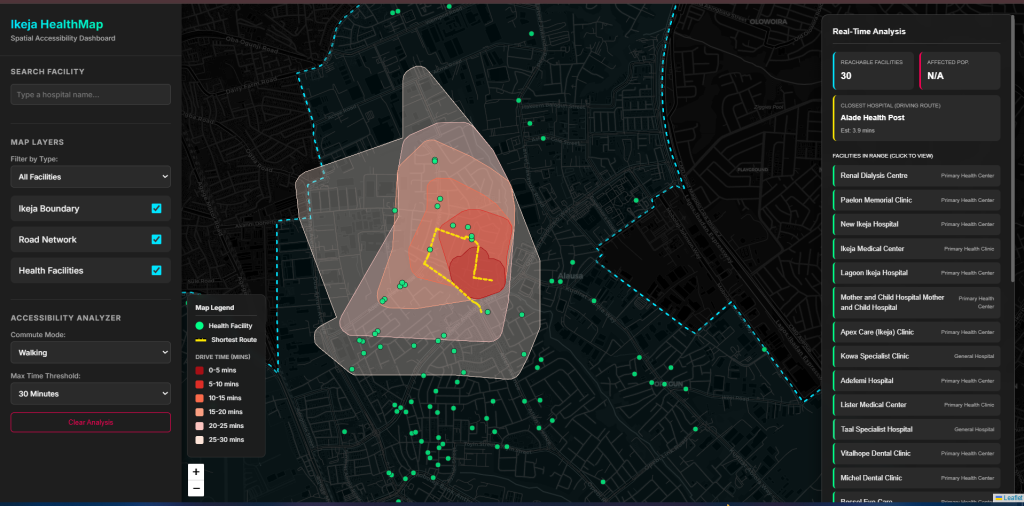
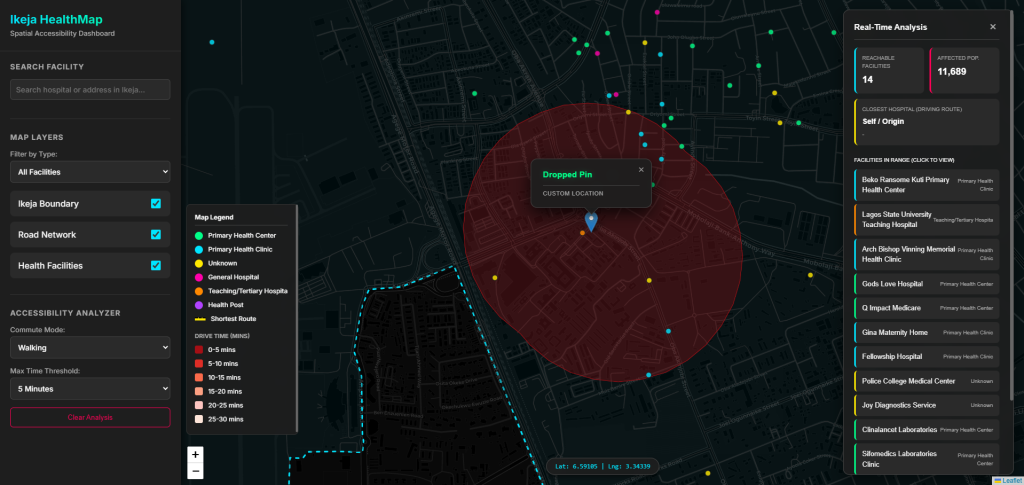
This web application implements an isochrone-based accessibility modeling framework that generates travel-time polygons from user-defined origin points. Upon selecting a location, the system computes multimodal network travel times and delineates reachable areas within specified temporal thresholds. The tool supports comparative analysis across transportation modes and provides a scalable interface for evaluating spatial accessibility, network performance, and urban connectivity.
LAND USE COMPARISON APP
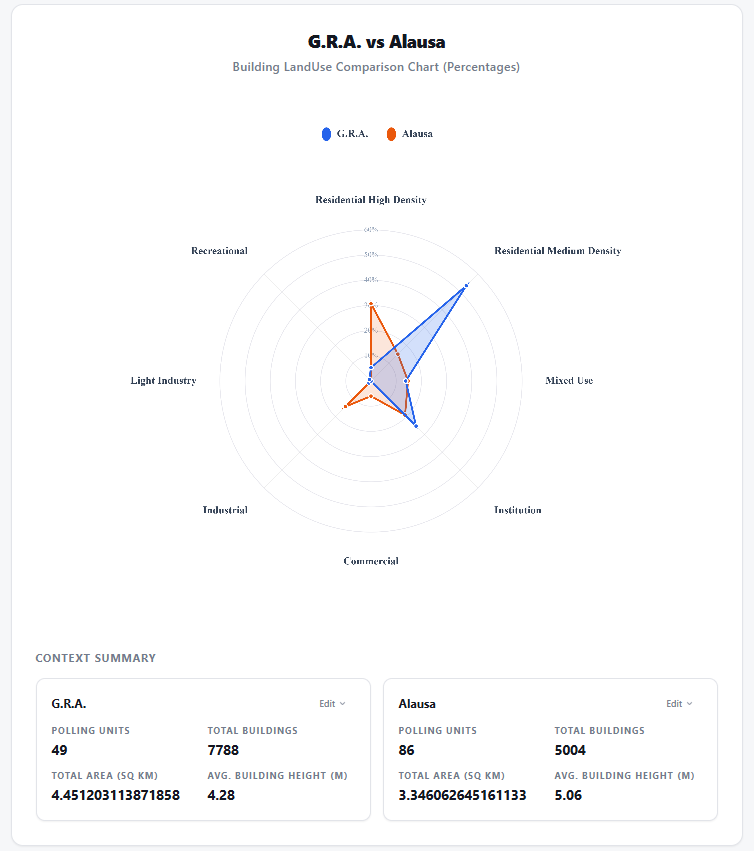
The Ward Comparison App is an interactive geospatial analytics tool designed to support detailed comparisons across administrative areas. Users can select and analyze multiple wards to access comprehensive datasets, including building information, land use classifications, polling unit distributions, and population statistics.
The platform presents these insights through intuitive visualizations and structured summaries, enabling users to identify spatial patterns, assess infrastructure distribution, and evaluate demographic and land use differences across regions. This tool supports applications in urban planning, policy development, electoral analysis, and resource allocation by transforming complex spatial data into accessible and actionable insights.