What If the Nearest Hospital Isn’t the Right Hospital?
Imagine this.
It is late at night in Lagos. Someone you love suddenly becomes seriously ill. You rush out looking for help. The first hospital cannot take the case. Another refers you somewhere else. You try another facility, hoping this will finally be the right one.
At that moment, you are not thinking about healthcare systems, referrals or logistics.
You are thinking: “Where can they treat my loved one?”
That is the painful question raised by the reported experience of a Lagos resident whose family moved between several healthcare facilities before she eventually received treatment. Her story should not be used to blame any particular hospital or claim that delays caused her death. But it exposes a problem Lagos residents should take seriously: finding emergency care is sometimes about more than finding a hospital. Emergency victims and their loved ones should not be burdened with finding the right hospital, it’s the job of first responders. In this case, an ambulance service and their EMS team.
But how do you get in touch with first responders?
This is the gap that the 911 Rescue application is specifically designed to address.
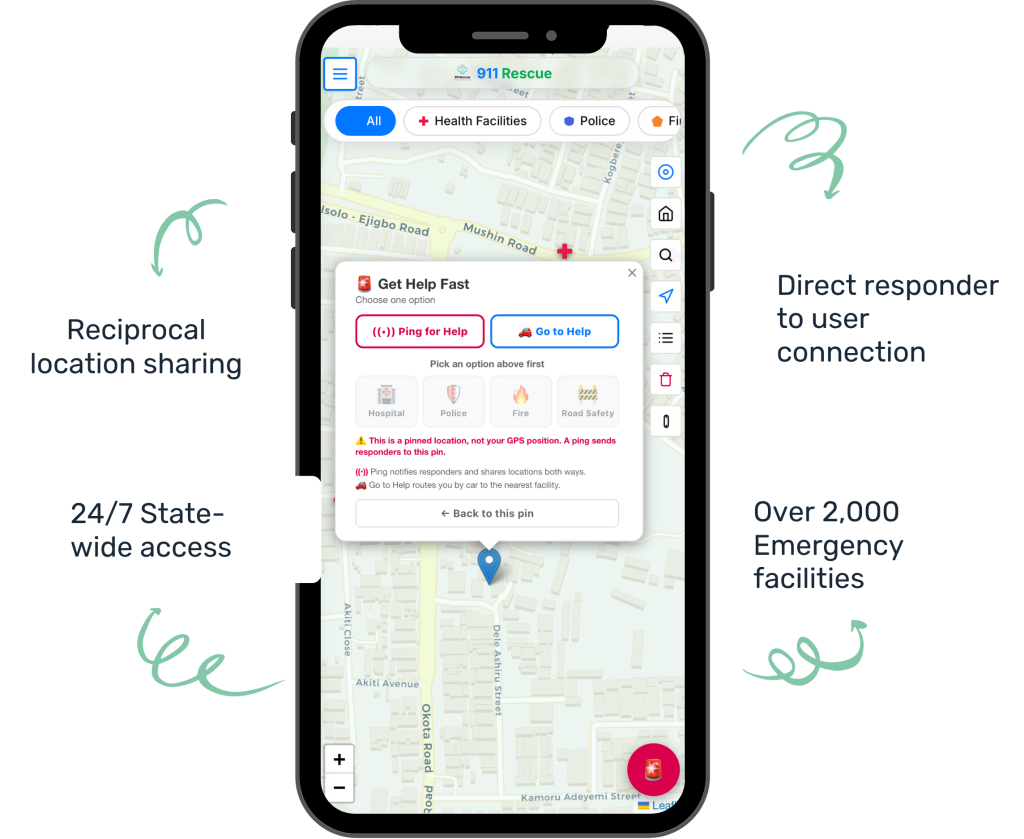
The idea is simple: when an emergency happens, people should not be burdened with logistics under high pressure. 911 Rescue connects their location → emergency response → appropriate facilities.
911 Rescue is built around location sharing, responder information, facility intelligence and travel-time awareness. More importantly, it is designed to help reduce the confusion surrounding emergency navigation.
It cannot replace doctors. It cannot replace ambulances. It cannot guarantee an outcome.
But it connects emergency victims to the right help.
Sometimes, the biggest emergency is not knowing where the emergency help is.
10 Lessons Lagos Residents Should Take From This
1. The nearest hospital may not be the right hospital
Distance does not automatically mean suitability. This is why 911 Rescue prioritizes connecting users with first responders.
2. Know more than one healthcare option
In case the only option is to find a healthcare facility, 911 Rescue provides information on over 2000 facilities.
3. Precise location matters
Knowing exactly where you are and being able to accurately share or describe your location saves time, and could save your life. 911 Rescue privately shares your coordinates with emergency responders, making it easier for help to find you.
4. Traffic can change everything
A hospital that looks close on a map may be much farther away in real travel time. 911 Rescue provides live traffic information.
5. Leave finding the right hospital to the trained experts
A hospital may exist nearby but may not have the required bed, specialist or emergency capability. That is why 911 Rescue strongly advices pinging for help during emergencies.
6. Referrals can become complicated
Recommendations from family and friends can come in handy, but different health emergencies could require different solutions. LET THE EMS TEAM DO THEIR JOB.
7. Emergency response is bigger than ambulances
It also involves communication, information, coordination and access to appropriate facilities. EMS and other responder teams are trained to handle high-pressure situations like emergencies.
8. Families need better information during emergencies
When people are frightened, searching through scattered information can waste precious time. Let 911 Rescue save your time.
9. Technology can help connect the missing pieces
Location intelligence can help connect people, responders, routes and healthcare facilities more effectively. Check out and bookmark our emergency platform: 911 Rescue – www.911rescueme.com.
10. Emergency preparedness starts before the emergency
Know who to call, where to go and how to communicate your location before you desperately need that information. Visit us at www.911rescueme.com.